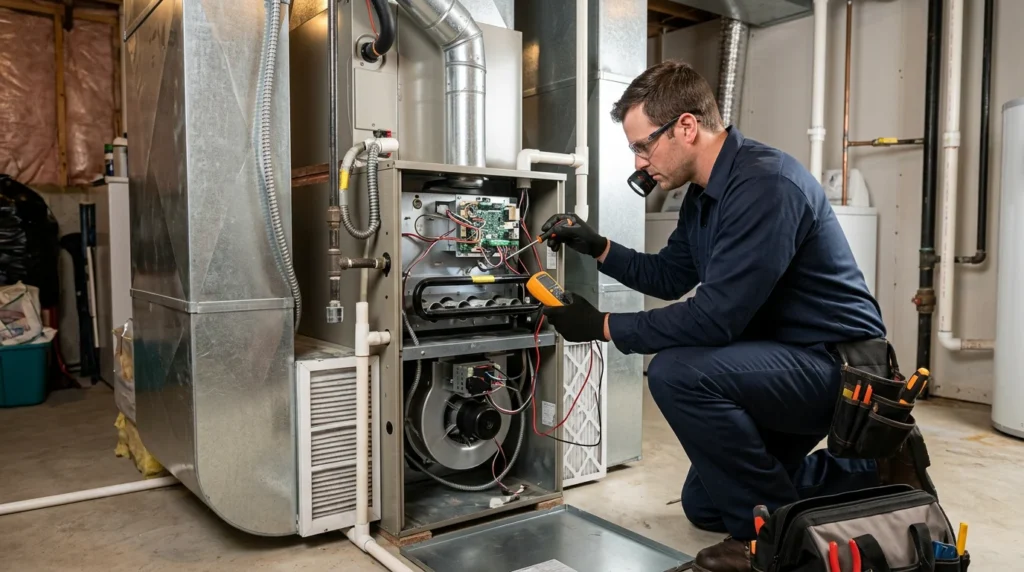
Quick answer: You usually need furnace repair if the unit still heats evenly, the heat exchanger is intact, and the problem is limited to parts like the igniter, flame sensor, blower components, or controls. Replacement becomes more sensible when repairs are frequent, safety issues are present (like suspected heat exchanger cracks), or the furnace is near the end of its typical 15–20 year lifespan and struggles to keep up.
Quick Ways to Tell Repair From Replacement
If your furnace is blowing cold air, short-cycling, or refusing to start, repair is often the right first step. Common fixable problems include a dirty flame sensor (starts then shuts off), a failing igniter (no flame at all), a clogged filter causing overheating, or a thermostat/wiring issue that makes the system act “random.” A technician can test safeties, verify gas pressure, and confirm proper ignition and airflow before you assume the whole furnace is done.
Replacement moves to the front of the line when there’s a safety concern or a pattern of breakdowns. Soot around the burner area, strong burnt-metal smells, or symptoms of carbon monoxide exposure (headaches, nausea, unusual fatigue) call for shutting the system off and getting it checked immediately. If you’re searching for furnace repair Good Hope GA, ask for a combustion check and a careful inspection of the heat exchanger, since that’s the component that can turn a “repair” into a “replace for safety” decision.
Age helps with the decision, but it isn’t the only factor. Many furnaces last around 15–20 years with decent maintenance. A newer unit with one clear failure is usually a repair. An older unit that’s noisy, uneven, and needing repeated service is often a replacement candidate even if it technically still runs.
Signs Your Furnace Likely Just Needs Repair
Some symptoms point strongly toward a targeted repair. A furnace that starts, then shuts off after a minute or two often has a dirty flame sensor, restricted airflow, or a pressure switch issue. A furnace that runs but won’t push air may have a bad capacitor, failing blower motor, or a control board problem. None of those automatically mean replacement.
Listen for clues. A single new rattle can be a loose panel or blower wheel. A high-pitched squeal can be a worn blower bearing or belt (on older systems). Clicking without ignition can indicate an igniter or gas valve/control issue. These are all diagnosable problems where a repair can restore safe, normal operation.
Also check the basics you can do safely: replace a clogged filter, confirm the thermostat is set to “Heat,” and make sure supply vents are open. If the furnace still short-cycles, trips a safety switch, or you smell gas, stop and call a pro.
When Replacement Is the Smarter Call
Replacement is usually justified if the heat exchanger is cracked or suspected to be compromised. That’s a safety issue, not a comfort issue. Another replacement trigger is recurring failures: if you’ve had multiple no-heat calls in a season or major components are failing one after another, you can end up chasing problems instead of fixing the root cause.
Comfort and performance matter too. If the furnace can’t maintain temperature during cold snaps, heats unevenly, or runs constantly despite clean filters and clear vents, the system may be undersized, ductwork may be restrictive, or the furnace may simply be worn out. A qualified contractor can measure temperature rise, static pressure, and combustion performance to see whether repair will actually solve the complaint.
Efficiency can tip the scales, but only after safety and reliability. Newer furnaces can be more efficient, but the “payback” depends on usage, fuel costs, and how close your current unit is to failing. If you replace, ask for proper sizing and duct evaluation so the new system doesn’t inherit the same airflow problems.
What to Ask During a Furnace Service Visit
Ask the tech to show you what failed and how they tested it. Useful specifics include: measured temperature rise across the furnace, any error codes, flame quality observations, and whether the inducer and pressure switch are operating normally. If the recommendation is replacement, ask what safety finding or performance measurement drove that conclusion.
Request a clear plan for next steps: what parts are being replaced, what maintenance is needed to prevent a repeat, and what warning signs should send you back to service quickly. If carbon monoxide is a concern, ask what they checked and what you should do at home (like confirming you have working CO alarms).
If you need help deciding between repair and replacement in Good Hope, Billy Butler HVAC is a solid place to start for a straightforward diagnosis and options you can understand.